Anne France Polajenko
Ballerina, Teacher, Writer
May 15, 1942 (Shanghai, China) – November 14, 2025 (Delray Beach, FL)
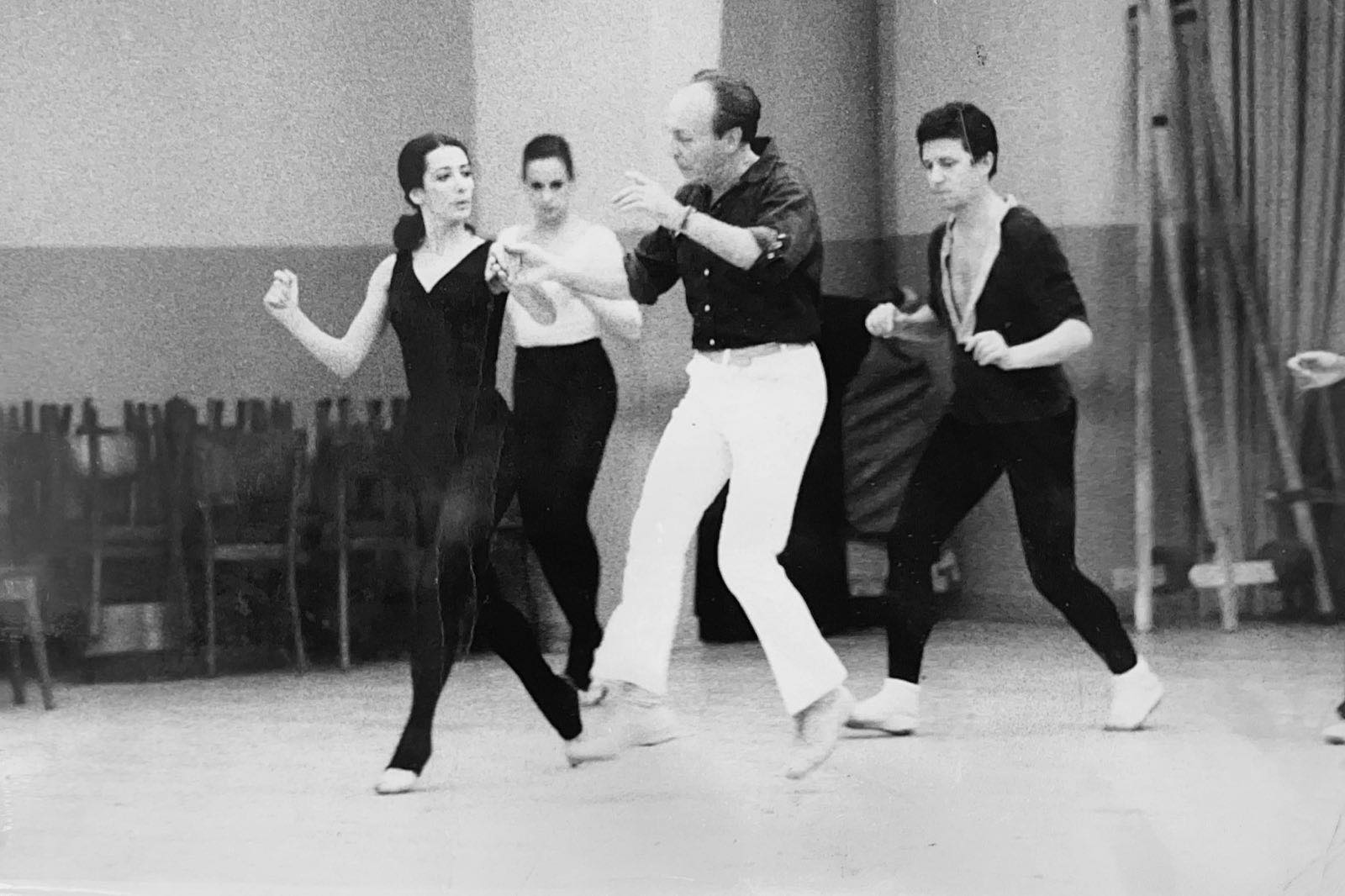
Anne, at left, with George Balanchine · Polajenko family collection
On this page
- 1942 — Born in Shanghai
- 1949 — First ballet class
- 1951 — Rome, and the moderns
- 1959 — La Scala, Milan
- 1961 — Geneva, first contract
- 1964 — Dancing Balanchine
- 1968 — Company régisseur
- 1971 — Marries Nicholas
- 1973 — To America, to teach
- 1976 — Houston Dance Center
- 1984 — Houston Grand Opera
- 1985 — Nice · Grande Parade du Jazz
- 1988 — HARID's first faculty
- 1990 — A school of her own
- 2002 — Pointe shoes, So Dança
Anne France Polajenko (1942–2025) was a French ballerina, ballet teacher, and writer. Trained at Rome's Academia Nazionale di Danza and Milan's famed La Scala ballet school, she danced as a soloist and principal with the Geneva Grand Théâtre Ballet, where she performed the repertory of George Balanchine under the choreographer himself. She went on to teach for more than four decades — co-founding Houston Dance Center with her husband Nicholas Polajenko, serving as Children's Ballet Mistress for Miami City Ballet's Nutcracker, and becoming a nationally recognized specialist in pointe shoe fitting.
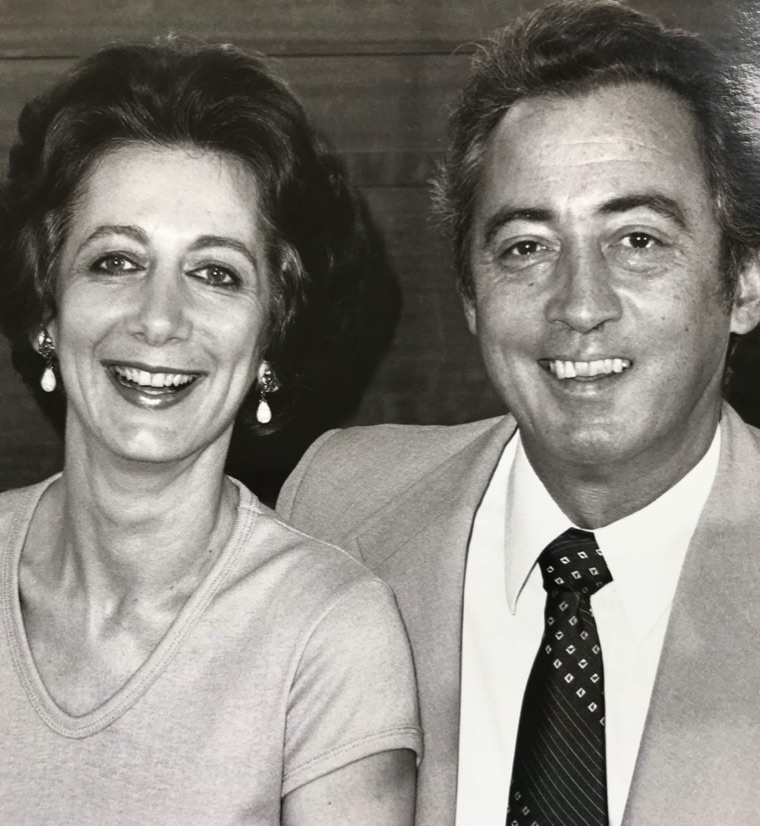
Full name: Anne France Polajenko (née Saint-Pol)
Note: Though born in Shanghai, Anne was of French nationality through her aristocratic Saint-Pol family. Professional biographies often described her as "French-born."
Part I: Early Life (1942-1949)
Birth During WWII
Anne was born May 15, 1942 in Shanghai, China during WWII, while her family lived under Japanese house arrest.[1][2]
"Oh yes, there was a surprise addition to this family. Myself, born in the middle of it all, nine years after my brother Michel."
Life Under Occupation
The family home was in the French Concession of Shanghai - a large three-story house with a vast garden surrounded by a high fence.
"Our house was located in the largest part of the international settlement, aptly named the French Concession."
Japanese soldiers guarded the gate; the family was under virtual house arrest.
"Although allowed to live in our own home, my family was under virtual house arrest, Japanese soldiers guarding the gate."
Anne's father built a bomb shelter underneath the garage and hid gold bars for survival.
"Toward the end of the war, when cash was gone and food was very scarce a bunch of carrots was worth one gold bar"
The family had a Dutch Jewish governess named Fanny who cared for the children despite being in extreme danger herself.
Anne's brother Michel was 10 years older and became her "nanny, playmate and protector all rolled into one."
Leaving China (1945-1946)
Anne was 4 years old when the family left China. They left with just the clothes on their backs and a few suitcases. Governess Fanny emigrated to Israel; the family never heard from her again.[2:1]
Anne received her first doll, "Rosie", upon arrival in America - a treasured memory she later wrote about.
"'What are you going to name her?' I thought for not more than three seconds. 'Rosie' I said."
Part II: Dance Training (1949-1961)
Washington D.C. (1949) - Age 7
Anne began ballet classes at the suggestion of her schoolteacher.
"I was about 7 years old. Actually, it was my school teacher who suggested it since it seemed I had a lot of energy and always danced my way in the school hallways!"
First teacher: Kathryn Mullownye (former George Balanchine dancer)[3]
"My first teacher was Kathryn Mullownye, a former dancer in George Balanchine's company who had quit dancing to marry a military man."
School location: Dupont Circle, second floor
First professional ballet experience: Ballet Russe de Monte Carlo
"I was so excited the first time we went to see The 'Ballet Russe de Monte Carlo'. This was the most famous company in America."
Anne won a local TV talent competition but could not accept the prize because the family was moving.
Rome, Italy (1951-1959) - Ages 9-17
The family moved to Rome when Georges joined the UN FAO.
Anne auditioned at the Rome Opera House ballet school but was rejected due to a scary director (Ms. Radice).
She was accepted at the Academia Nazionale di Danza under Jia Ruskaya.[3:1]
"Jia Ruskaya was originally Russian and had come to Italy many years before."
The academy was built on the Aventine Hill overlooking the Circo Massimo.
Anne attended the Overseas School of Rome (international school for diplomats' children).
Modern Dance Training: Anne took classes from pioneers Kurt Joos, Lottie Gosslar, and the Sakharovs.
"I got to take classes from what are now called the 'Modern dance pioneers'"
Fateful Encounter: Anne watched Harald Lander teach his wife Toni Lander (star of London's Festival Ballet), who was "often partnered by a young man I would marry many years later" - Nicholas Polajenko.
Milano - La Scala (1959) - Age 17
Anne graduated top of class in both 11th and 12th grade English in the same year.
"one of my proudest moments came when I graduated at the top of my class in both 11th and 12th grade English!"
She was accepted at the La Scala Opera House ballet school - only the second non-Italian ever accepted at that level.[3:2]
"By some miracle, I was accepted into the school - only the second non-Italian ever and the first in that high a level."
Director: Esmee Bulness (English) - a strict but great teacher
Anne could never join the La Scala company (Italian nationals only).
Part III: Professional Dance Career (1961-1973)
Geneva Grand Theatre Ballet (1961-1973)
Anne signed her first professional contract in 1961 and moved to Geneva, Switzerland.[3:3]
She was hired by choreographer friend Gilbert for the corps de ballet at the newly rebuilt Geneva Grand Theatre (state-of-the-art with three rotating hydraulic stages).
Anne performed as Soloist and Principal Dancer in every ballet of the classical repertory.[4]
What the Geneva press recorded
Anne danced under her maiden name, Anne Saint-Pol — which is why the Geneva record went unfound
for so long. Some thirty-eight notices survive in the
Journal de Genève, the Gazette de Lausanne, the
Tribune de Genève, La Suisse and the Courrier de Genève,
spanning 1964 to 1971 — the contemporaneous record of a career otherwise remembered only in her own
words.
September 1964 — La Somnambule. Her earliest known notice, dancing one of the paired
divertissement roles of the ballroom scene in George Balanchine's ballet, partnered by
Jean-Marie Sosso. She was dancing Balanchine in Geneva at twenty-two.[5]
August 1965 — La Somnambule again, at the Théâtre de verdure, Parc La Grange. An open-air
summer programme under ballet director Serge Golovine: Prokofiev's Symphonie classique,
Lifar's Suite en blanc, and the Act III pas de deux from The Sleeping Beauty.[6]
April 1966 — Petrouchka. In a triple bill with Menotti's Sébastien and Frank Martin's
Petite symphonie concertante, with Ernest Ansermet conducting the Orchestre de la Suisse
Romande and Golovine himself in the title role, the Journal de Genève named Anne among the
principals — "à la tête de toute une troupe qu'on peut admirer et féliciter sans réserve."[7]
May 1967 — The Sleeping Beauty. Golovine's full-length staging — prologue and three acts,
forty-two roles — with Beatriz Consuelo as Aurora and a young Armin Jordan in the pit. The
Gazette de Lausanne singled out Anne's pas de trois: "Un pas-de-trois excellent : celui d'Anne
Saint-Pol et Christl Siesz…"[8]
October 1966 — Métaphore. Golovine's major creation of the season, to Bach's third suite and
the sinfonia from Cantata 12, danced by thirty dancers in plain black leotards. The Tribune de
Genève admired Beatriz Consuelo "and beside her, the vigorous Liliane Van de Velde, Gerda Daum,
Anne Saint Pol, Anne Sarlat, Claude Darnet and Bernard Housseau."[9]
April 1967 — Frank Martin's La Tempête. For the French-language creation of the Swiss
composer's opera after The Tempest, Anne was one of three dancers who, the Courrier de Genève
wrote, "completed this imposing cast."[10]
October 1968 — opening the season. Vivaldi, a new creation and Giselle. The Tribune de Genève
paid her the same compliments it paid Claudine Kamoun and Aniko Csiky.[11]
March 1969 — billed as a soloist. The company's advertisements that spring print the ranks
plainly: "Solistes : Claudine Kamoun, Josette Mennecier, Anne Saint-Pol, Anne Sarlat, Christl
Siesz…" The same billing follows the company on tour to Nyon.[12][13]
September 1969 — Corrida, on television. Anne danced Pastora and Nicholas danced
Gitanillo — the two of them cast together, in named roles, in a ballet broadcast on Swiss
[14]
6 July 1970 — an all-Balanchine evening. La Somnambule, The Four Temperaments and
Symphony in C, with George Balanchine billed as the company's artistic adviser and
Alfonso Catà as ballet master. Anne is named in the first rank of the company's women. The
advertisement carries one more line: "Ce ballet sera filmé pour la télévision" — the performance
was filmed. Whether that recording survives in the Swiss broadcast archives is not yet known.[15]
October 1970 — La Valse, Concerto Barocco, Agon. Three more Balanchine works in a single
programme, Agon staged by Patricia Neary with Arthur Mitchell as guest — Geneva was only
the second company in Europe to dance it.[16] Balanchine's patronage was no honorary title: "He was
among us last week," Catà told La Suisse. "Nothing escaped him in our rehearsals, down to the
smallest detail."
November 1970 — the four little swans. Anne danced the Swan Lake quartet with Corinne Marguet,
Josette Mennecier and Maja Schweizer.[17]
March 1971 — four Balanchine works, and four New Yorkers. For the season's last ballet programme
Balanchine sent four of his own dancers from New York City Ballet — Patricia McBride,
Karin von Aroldingen, Marnee Morris and Jean-Pierre Bonnefous — who gave up part of their
annual leave to appear in Geneva. The bill was Divertimento No. 15, Episodes, Theme and
Variations, and Who Cares? in its first European staging. Catà cast the leading roles in
alternation with his own soloists: there were, he said, no longer any stars with untouchable
privileges.[18]
Choreographers She Worked With
George Balanchine, Antony Tudor, Nicholas Beriosoff, Serge Golovine
The Balanchine Years (1968-1973)
From 1968-73, Anne had the unique opportunity of performing the Balanchine repertory under the tutelage of the choreographer himself.
George Balanchine became Artistic Advisor to the Geneva Grand Theatre Ballet in 1969 — he is
billed as such on the company's 1970 programmes — giving Anne direct access to the master
choreographer. Alfonso Catà, who had danced under Balanchine at New York City Ballet, directed
the company from 1969 to 1973.
Anne danced 14 Balanchine ballets. Six are now confirmed against the Geneva press:
- "La Somnambule" (1964, 1965, July 1970)
- "The Four Temperaments" (July 1970)
- "Symphony in C" (July 1970)
- "La Valse" (revived October 1970)
- "Concerto Barocco" (October 1970)
- "Agon" (October 1970)
- "Serenade"
Anne also had works created especially for her during her time with the company.
Company Régisseur (1968)
In 1968, Anne was appointed company Régisseur (stage manager), in charge of coordinating company schedules, tours, costumes and shoes.
She was still doing it in 1970, when ballet master Alfonso Catà, asked by La Suisse who he
relied on, answered:
"Anne Saint-Pol — who really has a gift for public relations — and Pierre Polliand are régisseurs
as well as artists, and they carry out their duties with limitless dedication."[16:1]
The following spring La Suisse returned, and this time Anne spoke for herself — on what it meant
for a company in Geneva to be lending a dancer to the Hamburg Opera for Agon:
"It is a chance for exchanges that opens very wide horizons… so the ballet secures for itself,
more and more, a reach that is genuinely worldwide."
The paper introduced her as "at once artist, co-régisseur with Pierre Polliand, and the most
effective and most valuable of public relations people — she could even be a professor of the
subject." It would be another thirty-two years before So Dança made exactly that her job.[18:1]
Meeting Nicholas
Nicholas Polajenko was appointed Principal Dancer & Ballet Master for the Geneva company in 1966.
They danced together — as Gitanillo and Pastora in Corrida in 1969 — and married in Geneva on
8 April 1971, two years before they left for the United States.[19]
Retirement from the Stage (1973)
Anne retired from performing in 1973.
She and Nicholas moved to the United States to pursue teaching careers.
Part IV: Teaching Career (1973-2017)
Point Park College, Pittsburgh (1973-1974)
The Polajenkos' first teaching position in America.
Houston Ballet (1974-1976)
Anne served as Ballet Mistress of Houston Ballet — a title recorded in the company's own staff
listing, not only in family papers.[20]
The Dance World yearbook for 1976 sets out the company under artistic director Ben Stevenson,
with James Clouser as acting artistic director and choreographer, and names its ballet staff:
Ballet Masters, Hiller Huhn, Nicholas Polajenko; Ballet Mistress, Anne Polajenko
Anne and Nicholas ran the company's ballet staff together, in a season whose guest artists included
Edward Villella and Jean-Pierre Bonnefous. The previous year's volume lists Nicholas alone as
ballet master, which places Anne's appointment in the 1975-76 season.
Houston Dance Center (1976-1988)
Nicholas and Anne co-founded Houston Dance Center and served as co-Artistic Directors —
listed as such, year after year, in Dance Magazine's national school directory: "Houston Dance
Center, Anne & Nicholas Polajenko, Dirs., 2018 West Gray."[21]
The school opened on 7 September 1976. Its first advertisement, in a Houston neighbourhood
weekly that August, called it "the exciting new school, created and directed by Anne and Nicholas
Polajenko," a non-profit, and listed a curriculum unlike most dance schools': alongside classical
ballet, modern and jazz came choreography, music theory, dance history and dance journalism.
Dance Magazine noticed it nationally within its first term, writing that the Center "offers a
uniquely complete list of courses and activities in dance."[22][23]
It was built to hold an audience as well as a student body. Memberships were offered to ballet
patrons who were not dancers, and contributing members could join the school's films, lectures,
ballet previews and field trips. The same profile records something Anne had done that spring: "a
special interest in teaching and understanding of ballet to young people," and a tour of ten local
public schools with a group of her students as part of the Young Audiences programme of 1976.
The school also had a performing company, Festival Ballet USA, which the two of them directed.
In June 1982 it danced a programme of classical and modern work for Galveston Arts at the
1894 Grand Opera House in Galveston. Previewing that performance, the Baytown Sun wrote that
the Polajenkos "have worked with every major choreographer from Balanchine to Tudor, from Alvin
Ailey to Bronislava Nijinska," and that Anne, after a fifteen-year performing career in Europe, had
turned her attention to training dancers and restaging ballets.[24]
Years later Anne would write a ballet mystery novel set in a company she called Ballet U.S.A.
Closer to home, the company danced an evening of classical and contemporary ballet at Hamman Hall,
Rice University, on 31 May 1978, to benefit the school's scholarship fund. The programme opened
with "Adagio," choreographed by Anne, and went on to work by Nicholas, by Gilbert Rome and by
James Clouser. Tickets were five dollars, three for children; the box office was the school itself.
The notice observed that the Center, then only two years old, had already placed dancers in major
schools in New York and San Francisco.
Each summer the two of them taught a repertoire workshop for advanced dancers and teachers, working
through sections and pas de deux from Les Sylphides, Swan Lake, The Sleeping Beauty and
Pas de Quatre across three weeks, ending with a performance in the studio. The announcement is
exact about what they thought they were passing on: they would teach "not only the choreography, but
the styles of each ballet."
The Center's name travelled. Dance schools out in the Houston suburbs affiliated themselves with it
and advertised the connection as a credential — one called itself "a member of the prestigious
Houston Dance Center, directed by Anne and Nick Polajenko" — and teachers across the region were
still listing study with the Polajenkos in their own biographies well into the 1980s.
Choreographing for Houston Grand Opera (1984-85)
Anne's work reached beyond ballet. Houston Grand Opera's Madama Butterfly premiered at Jones
Hall on 18 January 1985 — the company's first production by the British film director Ken
Russell, staged on Puccini's seldom-used original 1904 Milan score, with Lawrence Foster
conducting. Russell set the action in the red-light district of pre-war Nagasaki and closed it on the
mushroom cloud of the atomic bomb.
The choreography was Anne's. The Baytown Sun's preview names her among the production's creative
staff: "Houston choreographer Anne Polajenko is providing choreography for the show, and Master
Kim Soo, an 8th degree black belt in Korean Tae Kwon Do and faculty member at Rice University, is
providing training in martial arts."
Nice, and the Grande Parade du Jazz (1985)
That same year the Center's dancers crossed the Atlantic. In 1985 Anne and Nicholas took a troupe of
Houston Dance Center students to Nice — one of Houston's sister cities — on a joint concert tour
with the Jazz Ensemble of Houston's High School for the Performing and Visual Arts, led by
Robert "Doc" Morgan. The two groups travelled and performed together, the young dancers sharing
the bill with the jazz band, whose own appearances at the Grande Parade du Jazz — the open-air
festival then produced by the American impresario George Wein — had been arranged for the visit.
The Houston press caught the trip as it happened. A July 1985 dance-school notice in the South Belt
Leader reported that a student — also a pupil at the High School for the Performing and Visual Arts —
was "in Nice, France by invitation of the French government," performing at the opening of the city's
new Acropolis convention center, "on scholarship at the Houston Dance Centre under the direction of
Anne and Nick Polajenko."[25] That autumn The Texan looked back on the HSPVA ensemble
as having been "such a sensation at the 1985 Grand Parade du Jazz in Nice, France."[26]
Morgan filmed the trip himself on Super-8 with sound, and in 2015 he posted the edited reel online.
Its title cards read "Dancers from the Houston Dance Center, Nick and Anne Polajenko, directors":
HSPVA Jazz Ensemble and Houston Dance Center in France, 1985.[27]
They taught beyond the school, too. When Houston's Jewish Community Center began a master class
series in December 1976, it opened with Nicholas and announced Anne among the "distinguished
dancers" to follow.[28] They were the ballet instructors for Theatre Under the Stars, Houston's free
summer musical company, and are credited as such in its printed programmes — including its
production of 1776. In November 1978 they drove down to Portland, near Corpus Christi, to give two
days of master classes to a small civic ballet company and set two variations on its dancers.[29]
Anne's teaching at Theatre Under the Stars in the summer of 1976 ran to five classes, from
Fundamentals of Ballet for Adults to an Intermediate/Advanced class including pointe work that
met six days a week. She was teaching pointe twenty-six years before it became her profession.[30]
"Ballet… from France with Love" (1977)
On 14 January 1977 Anne gave a lecture-performance of her own at the Alliance Française de
Houston — an account of ballet's history, with dancers from the Center demonstrating steps and
tracing them from the court of Louis XIV to the present, and colour slides. Admission was free, the
public invited. The notice described her as "former ballet mistress of Houston Ballet and presently
Co-director of the Houston Dance Center."
[31]
It is the earliest record of Anne speaking publicly on dance — twenty-six years before she was a
featured speaker at conferences in Las Vegas and New York.
Students from Houston Dance Center went on to join:
- American Ballet Theatre
- Cleveland Ballet
- San Francisco Ballet
- Ballet West
- Joffrey II
- New York City Ballet
The Houston papers named some of them as they left: Lee Hutton, who studied at the Center before
the School of American Ballet and San Francisco Ballet and joined the Joffrey II Dancers;
Courtney Laves, who trained there on full scholarship and went on to the Atlanta Ballet and
the South Carolina Ballet Theatre; and Lara Bonasera, who apprenticed with Festival Ballet
USA and won a scholarship to Ballet West. One sixteen-year-old, profiled in the summer of 1983
after solo roles with the company, had already been offered a Ballet West contract for the day she
finished school.
Anne was honored by the City of Houston and the State of Texas for her commitment on behalf of the arts.
Harid Conservatory, Boca Raton (1988-1989)
When the HARID Conservatory enrolled its first students in 1988, Anne and Nicholas were hired as
its first ballet instructors — a fact recorded in the school's own twenty-fifth anniversary
history.
There was no campus yet. The buildings existed only as architectural drawings, so classrooms were
rented at the College of Boca Raton and converted into studios, and the dancers were housed in a
nearby hotel and bussed to class. The most notable student of that founding year, Elizabeth Gaither,
went on to American Ballet Theatre and The Washington Ballet.[32]
In the autumn of 1989 the Polajenkos were succeeded on the faculty by Marjorie Tallchief — the
ballerina Nicholas had partnered at the Harkness Ballet thirty years before.
Her own school: Tequesta and Jupiter (1990-1994)
Anne then did in Florida what the two of them had done in Houston: she built a school and gave it a
company to dance in.
South Florida Ballet Academy was incorporated in July 1990 at 152 Bridge Road, Tequesta, with
Anne as one of its three directors. Four months later, in November, came South Florida Youth
Ballet — a non-profit at the same address, with Anne as its registered agent and a board of six.
The academy was wound up in the spring of 1993 and the youth company lapsed the following year.[33]
Ballet Florida
Anne served as Ballet Mistress.
Miami City Ballet (8 Years)
Anne served as Children's Ballet Mistress for George Balanchine's Nutcracker for 8 years.
"Some years ago I had the privilege of serving as Children's Ballet Mistress for Miami City Ballet's production of George Balanchine's 'The Nutcracker'. Edward and Linda Villella had entrusted the job to me, something for which I will be eternally grateful."
- Entrusted with the position by Edward and Linda Villella (Artistic Director)
- Each cast: 74 dancers ages 8-14
- Performed at Kravis Center in West Palm Beach
- Coordinator for MCB's Outreach Program
- All children outfitted with So Dança shoes
Notable students Anne trained:
- Anna Gonzales - from smallest Angel to Marie, graduated Harid Conservatory
- Tommy Batchelor - young Prince age 10, went to Broadway's "Billy Elliott"
- Treyden Chiaravalloti - young Prince, now at Julliard School
- Madison Russo - Angel to Candy Cane, now with Houston Ballet II
2003: Granddaughter Renee Polajenko danced in the Angels cast at Kravis Center.
Southern Dance Theatre (2002-2017)
Anne taught ballet at Southern Dance Theatre in Florida starting at least February 2002.[34]
Anne wrote monthly newsletters for students on injury prevention, nutrition, and dance history.[34:1]
December 2017: Staged "TCHAIKOVSKY TRILOGY" recital featuring Swan Lake, Sleeping Beauty, and Nutcracker excerpts.
Teaching beyond the studio
In the spring of 2000 Anne led the dance strand of a twelve-week Heritage Arts programme at
Old School Square in Delray Beach, working with thirty children from Plumosa Elementary School.
They performed at the Crest Theatre that April. The Sun-Sentinel, reporting it, called her segment
"the anchor for the activities" and noted she had by then been teaching dance for twenty-eight
years.[35]
She was still at it a dozen years later, judging a competition for the Boca Ballet Theatre Guild in
2012.[36]
Dance Masters of America
Anne served as a guest teacher and choreographer for Dance Masters of America.
Presidential Scholar Recognition
Anne was recognized by the National Foundation for the Arts as a Teacher of a Presidential Scholar.
Part V: So Dança Career (2002-2018)
December 2002: Appointed PR Officer
Anne was appointed Public Relations officer for So Dança's North American operations.
Pointe Shoe Specialist
Anne became a specialist in pointe shoe fitting. In 2002, she joined So Dança as Shoe Specialist in addition to her Public Relations role.
She conducted seminars on pointe technique and shoe fitting across the United States and Canada for dance schools, stores, and conferences.[37]
"correct shoe fit is essential. I care about what dancers put on their feet because I care so much about dance."
October 2002: Brazil Competition
Anne represented the United States on the jury of the 1st International Cecilia Kerche Ballet Competition in Brazil.
Competition held in Osvaldo Cruz (near Matto Grosso), headquarters of So Dança/Trinys.
A website of their own
Anne and Nicholas built and ran a website dedicated to pointe shoe education, publishing articles on
pointe readiness, fitting, care, and ballet technique. Anne wrote most of it; Nicholas took over the
newsletters from July 2011.
Their writing from that site is preserved here, in Anne's Pointe Shoe Guide.
Part VI: Writing and Creative Works
Autobiographical Works
- "Memories" - Detailed autobiography covering dance training from Washington D.C. to Geneva
- "Rosie" - Childhood memoir about life in Shanghai during WWII
- "The Great Faces of Dance" - Reflections on 60 years of witnessing ballet evolution
Fiction Writing
"Murder in First Position" - Mystery novel manuscript set in a ballet company
- Story set in Geneva's Grand Theatre with fictional ballet company "Ballet U.S.A."
- Protagonist: Myra, a senior soloist
- Draws on Anne and Nicholas's intimate knowledge of ballet world and Geneva theater
Published Articles
- "Mother" - Published article about her mother Renée as the ideal "Ballet Mother"
- Numerous articles on pointe shoe fitting and ballet technique for the couple's own pointe-shoe website, now collected in Anne's Pointe Shoe Guide
In the Archives
Much of Anne's career survives in institutional collections. Most of this material is still under
copyright and cannot be reproduced here, but it can all be read or viewed at the source.
Newspapers
- Le Temps archives — free, full-text searchable. The Journal de Genève and the Gazette de Lausanne follow the Grand-Théâtre ballet through the years Anne danced in it, including the 1967 Belle au Bois dormant and the company's 1970 programmes.
- e-newspaperarchives.ch — the Swiss press archive, free and full-text searchable. Source of the Tribune de Genève, La Suisse and Courrier de Genève notices cited on this page, among them Robert Burgel's reviews of the company in 1970 and 1971.
- The Portal to Texas History — the University of North Texas newspaper archive, free and full-text searchable. The Houston-area weeklies that covered the Houston Dance Center from its opening in 1976, and the master classes Anne taught across Texas.
Institutions
- HARID Conservatory — the Conservatory's anniversary retrospective, recalling Anne and Nicholas as its first ballet faculty.
- Woodson Research Center, Rice University — the Theatre Under the Stars Guild Scrapbook, 1976–1977, which records the Houston Dance Center's first season.
- Florida Department of State, Division of Corporations — the incorporation records for South Florida Ballet Academy (1990) and South Florida Youth Ballet (1990), the schools Anne founded after Houston.
In print
- The Pointe Book: Shoes, Training & Technique — Janice Barringer and Sarah Schlesinger, 2nd edition, Princeton Book Company, 2004. Anne's fitting expertise is cited in the standard reference on the subject.
- Anne's Pointe Shoe Guide — her own writing on fitting, breaking in and caring for pointe shoes, gathered here from the newsletters and articles she published between 2002 and 2011.
Death and Legacy
Anne F. Polajenko (May 15, 1942 – November 14, 2025)
Anne passed away November 14, 2025, at age 83.
She was survived by son Alexei Polajenko and grandchildren including Renee Polajenko.
See also: Nicholas Polajenko | Saint-Pol Family History | Anne's Pointe Shoe Guide | Student Reflections
References
Hospital admission record confirming date of birth, family archive. ↩︎
Anne Polajenko, Rosie, unpublished childhood memoir, family archive. ↩︎ ↩︎
Anne Polajenko, Memories, unpublished memoir, family archive. ↩︎ ↩︎ ↩︎ ↩︎
Anne Polajenko, professional biography, family archive. ↩︎
"Au Grand-Théâtre: spectacle de ballets", La Suisse, 30 September 1964. ↩︎
"Au Théâtre de verdure: deuxième spectacle du Ballet du Théâtre", Journal de Genève, 14 August 1965, p. 13. View ↩︎
"Au Grand-Théâtre: spectacle de ballet", Journal de Genève, 15 April 1966, p. 12. View ↩︎
"Au Grand-Théâtre de Genève: la « Belle au Bois dormant » triomphe", Gazette de Lausanne, 5 May 1967, p. 5. View ↩︎
"Six représentations et trois créations de Golovine pour le ballet (modifié) du Grand-Théâtre", Tribune de Genève, 29 October 1966, p. 11. View ↩︎
"Le Grand Théâtre de Genève crée la version française de La Tempête de Frank Martin", Courrier de Genève, 12 April 1967. ↩︎
"Le Ballet du Grand-Théâtre ouvre sa saison avec Vivaldi, une création et Giselle", Tribune de Genève, 2 October 1968. ↩︎
Advertisement listing the company's soloists, Tribune de Genève, 20 March 1969. ↩︎
"Le Grand-Théâtre de Genève à Nyon", La Suisse, 27 March 1969. ↩︎
"Corrida", Journal du Jura, 15 September 1969; and "Radio-TV", La Suisse, 15 September 1969. ↩︎
Advertisement for the ballet programme of 6 July 1970, Journal de Genève, 29 June 1970, p. 9. View ↩︎
Robert Burgel, "La transformation du ballet du Grand-Théâtre: de la qualité sans étoiles", La Suisse, 8 October 1970. View ↩︎ ↩︎
"Ballets du Grand-Théâtre: néo-classicisme de Catà", Tribune de Genève, 28 November 1970. ↩︎
Robert Burgel, "Un quatuor new-yorkais exceptionnel au Grand-Théâtre: une communauté de travail à l'échelle mondiale", La Suisse, 22 March 1971. View ↩︎ ↩︎
"Mariages célébrés jeudi 8 avril", Tribune de Genève, 14 April 1971. ↩︎
Dance World 1976, vol. 11, Crown Publishers, 1977, p. 151. ↩︎
"Where to Study", Dance Magazine, October 1976. ↩︎
Advertisement announcing the Houston Dance Center, The Bellaire & Southwestern Texan, 25 August 1976, p. 3. ↩︎
"Houston Dance Center Begins Classes This Week", The Bellaire & Southwestern Texan, vol. 24, no. 51, 8 September 1976, p. 5. ↩︎
"Galveston Hosts Houston Dancers", The Baytown Sun, 18 June 1982, p. 10. View ↩︎
"dance news", South Belt Leader (Houston), vol. 10, no. 23, 11 July 1985, p. 11. View ↩︎
"HSPVA holds jazz bash", The Texan (Bellaire, Tex.), vol. 32, no. 10, 6 November 1985, p. 11. View ↩︎
HSPVA Jazz Ensemble and Houston Dance Center in France, 1985, film by Robert "Doc" Morgan (Super-8 with sound, 1985; edited and posted to YouTube, 2015). View ↩︎
"Polajenko to Teach Master Class", The Center News, Jewish Community Center of Houston, 25 November 1976. View ↩︎
"Master Ballet Classes Given Locally", Portland News (Portland, Texas), 30 November 1978, p. 4. ↩︎
Theatre Under the Stars Guild Scrapbook, 1976–1977, Woodson Research Center, Rice University, pp. 65, 98. View ↩︎
"Ballet Study Planned For Alliance Jan. 14", The Bellaire & Southwestern Texan, 5 January 1977, p. 13. ↩︎
Gordon Wright, "First Love: A 25th Anniversary Retrospective", The HARID Conservatory. View ↩︎
South Florida Ballet Academy, Inc. (doc. L89235, filed 26 July 1990) and South Florida Youth Ballet, Inc. (doc. N41041, filed 27 November 1990), Florida Department of State, Division of Corporations. ↩︎
Anne Polajenko, biography prepared for Southern Dance Theatre, family archive. ↩︎ ↩︎
"Rhythm of Life", Sun-Sentinel, 16 April 2000. ↩︎
"To the pointe: Boca Ballet Theatre Guild hosts an afternoon of dance", Sun-Sentinel, 13 June 2012. ↩︎
Janice Barringer and Sarah Schlesinger, The Pointe Book: Shoes, Training & Technique, 2nd edn, Princeton Book Company, 2004. ↩︎