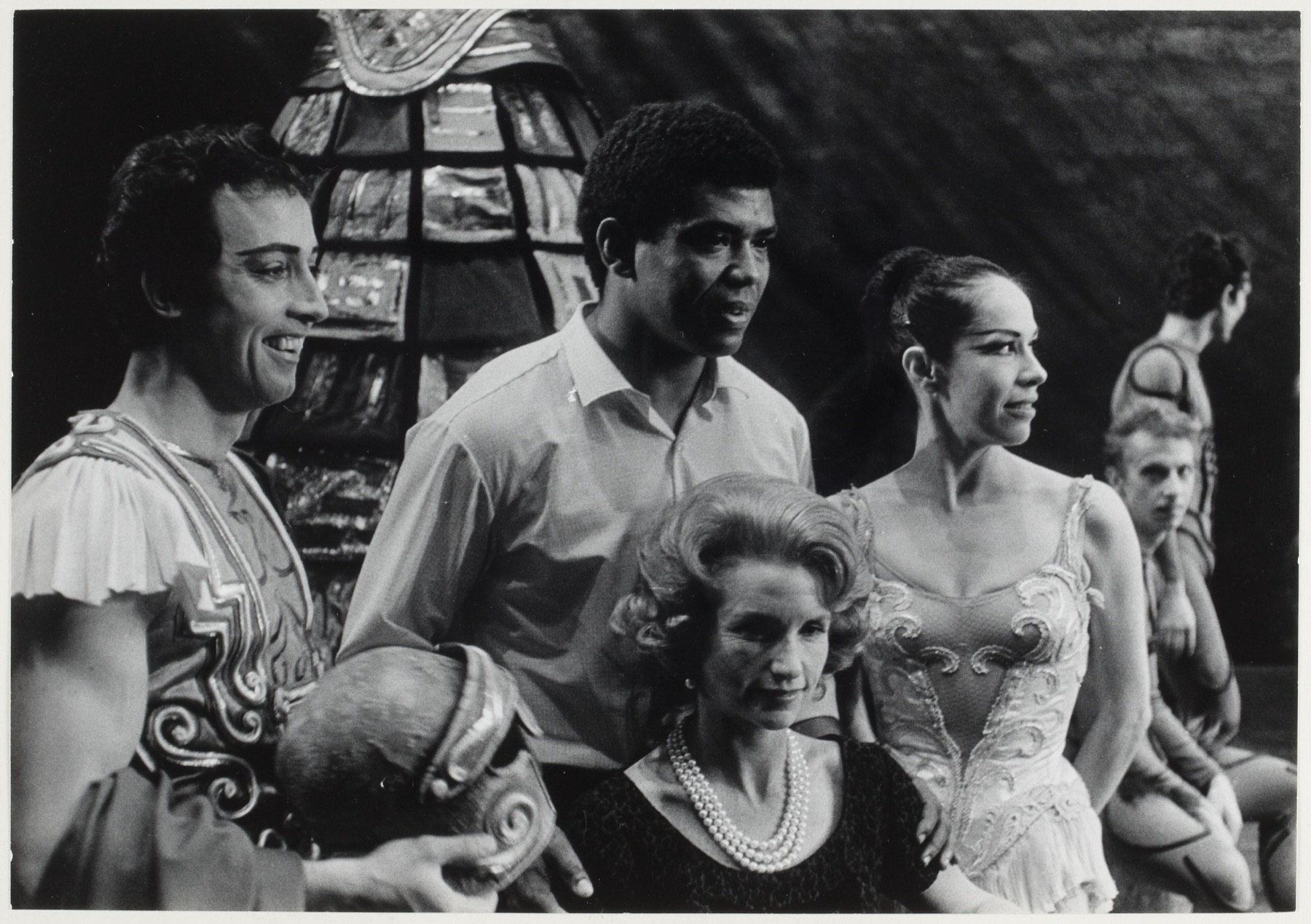
Nicholas Polajenko
Principal Dancer, Ballet Master, Teacher
1930 (New York City) – August 4, 2015 (Delray Beach, FL)
Roger Pic / Bibliothèque nationale de France
On this page
- 1930 — New York childhood
- 1947 — Broadway
- 1948 — To Paris
- 1954 — Festival Ballet
- 1957 — Corrida created
- 1958 — The Cuevas years
- 1960 — Sleeping Beauty
- 1962 — Touring with Golovine
- 1966 — Geneva, and Anne
- 1968 — Danseur étoile
- 1969 — Houston, and gym-jazz
- 1971 — Ballet on television
- 1973 — Teaching in America
- 1976 — Houston Dance Center
- 1985 — Nice · Grande Parade du Jazz
Nicholas Polajenko (1930–2015) was an American ballet dancer, ballet master, and teacher. A native of New York City trained by the Russian masters Anatole Vilzak and Ludmilla Schollar, he rose to principal dancer with London's Festival Ballet, the International Ballet du Marquis de Cuevas, and the Ballet du Grand Théâtre de Genève, partnering ballerinas such as Tamara Toumanova, Marjorie Tallchief, and Yvette Chauviré. In Geneva he met his wife, ballerina Anne Polajenko; together they moved to the United States in 1973 and co-founded Houston Dance Center, training dancers who went on to companies worldwide.
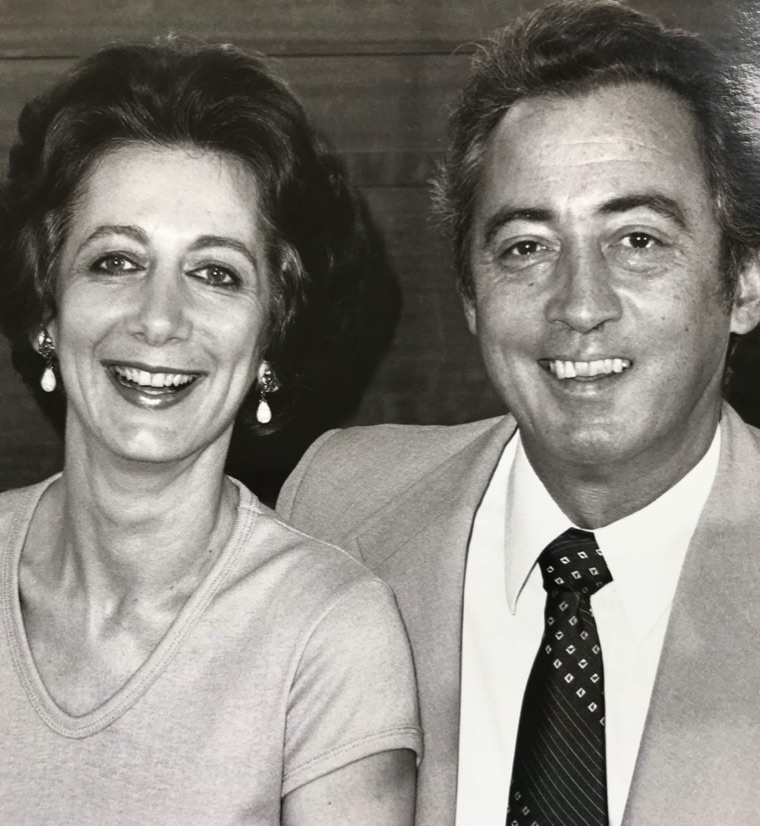
Part I: Early Life and Training
New York City Childhood
Nicholas Polajenko was a native of New York City.
He grew up on 140th Street, corner building of Hamilton Place.
Training with Russian Masters
Nicholas was trained by the famed Russian teachers Anatole Vilzak & Ludmilla Schollar.[1]
"A native of New York City, Nicholas Polajenko was trained by the famed Russian teachers Anatole Vilzak & Ludmilla Schollar."
Languages
In addition to his native English, Nicholas was fluent in French and Russian.
Part II: Broadway Career (Pre-1948)
Before going to Paris in December 1948, Nicholas appeared in two Broadway musicals:
- "Music In My Heart"
- "Annie Get Your Gun"[2]
"Before going to Paris France in December 1948 he was in two Broadway Musicals. Music In My Heart and Annie Get Your Gun."
Part III: European Dance Career (1948-1973)
Recognition
Nicholas was "soon recognized as a dancer of exceptional technique and acting versatility."
Principal Dancer with Major Companies
Nicholas rapidly rose to the rank of Principal Dancer with:
- Metropolitan Ballet
- Ballet des Champs Élysées
- Ballet Roland Petit
- London's Festival Ballet
- International Ballet Marquis de Cuevas
- Geneva Grand Théâtre Ballet
"rapidly rose to the rank of Principal Dancer with such companies as the Metropolitan Ballet, Ballet des Champs Elysees, Ballet Roland Petit, London's Festival Ballet and the International Ballet Marquis de Cuevas."
c. 1951: Roland Petit's Les Ballets de Paris
A souvenir programme from the company's American tour carries a "Who's Who in the Cast" note that is
the earliest independent account of his beginnings:
One of only three Americans in Les Ballets de Paris is New York-born Polajenko, who is of Russian
parentage. He has studied here with Vilzak-Shollar, and danced in Music in My Heart and
Annie Get Your Gun. After a year with Les Ballets des Champs-Élysées in Europe he joined the
Petit troupe in May, and alternates with Serge Perrault as Don José and as the Toreador in
Carmen.[3]
Roland Petit's Carmen — made in 1949 for Zizi Jeanmaire — was the sensation of post-war
European ballet. Nicholas danced both of its male leads.
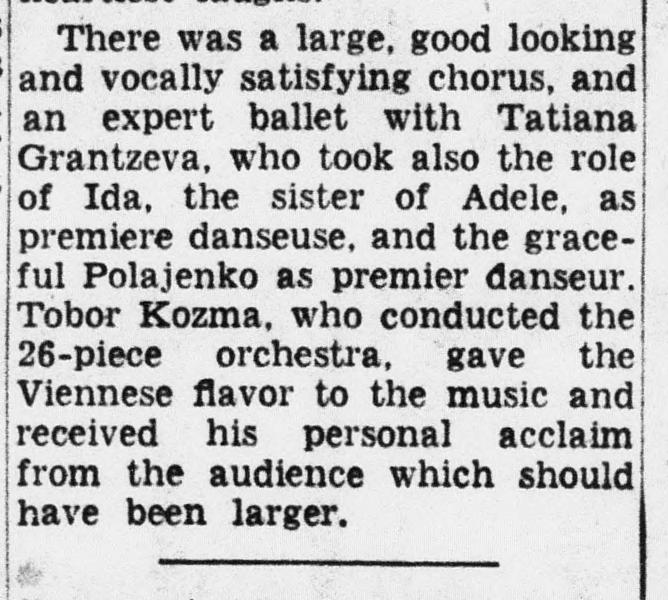
1951: A Washington Notice
The earliest known press notice of Nicholas by name appears in The Evening Star of Washington, D.C.
on 26 December 1951. Reviewing the opening of the Metropolitan Opera's Die Fledermaus at the
Gayety Theater, the critic Alice Eversman closed her column with the dancing.[4]
1954: London's Festival Ballet
Nicholas joined London's Festival Ballet at the beginning of March 1954, on a one-year
contract — billed on the playbills as Nicholai Polajenko — in a company led by Anton Dolin as
artistic director, alongside John Gilpin, Oleg Briansky, Natalie Krassovska and
Belinda Wright, with Tamara Toumanova, Violette Verdy and Toni Lander appearing as
guest artists. He went on the company's USA tour that winter, presented by Sol Hurok.[5]
He arrived from a partnership with Tatiana Grantzeva — the ballerina of the 1952 Trio con Brio
premiere — with whom he had toured for Ted Shawn's Jacob's Pillow company through 1952 and 1953, as
far as Peru. Britannica Book of the Year for 1953 records that touring company by name.
The British dance press followed the season closely, and his roles are recorded in it: Phoebus
in Nicholas Beriozoff's Esmeralda opposite Nora Kovach, Prince Siegfried in Swan Lake, the
Hussar in Massine's Le Beau Danube, and The Nutcracker with Kovach in July. He was cast for
Albrecht in Giselle as well.
The critics disagreed about him, which is its own kind of compliment. Dance and Dancers found him
"an unassuming partner, modest and direct, who lifts well and without fuss," with "a stylish
competence, with high accurate air-turns and precise beats," adding that "he uses his arms more
eloquently than most." Ballet Today, reviewing the same Esmeralda, thought he "must work harder,"
faulting "lax movement, thoughtless finishing and an air of not caring overmuch."[6][7]
In August 1955 he danced in Harald Lander's Études at the Royal Festival Hall, in a cast with
Toni Lander, John Gilpin and Anton Dolin.[8]
It was in this company that he met the British dancer Daphne Dale. They married on
16 August 1954.[9] At the end of 1955 the two of them left Festival Ballet together to dance a
short season in East Africa — Dale had been born in Nairobi.[10]
1956-57: Brazil, and a Contract with the Marquis
In December 1956 Nicholas and Daphne Dale appeared as guest artists with the newly founded
Ballet do Rio de Janeiro. They returned to New York in January 1957, where the
Marquis de Cuevas signed them both to a year's contract — the beginning of the six years that
would define his performing career.[11]
August 1957: Corrida, Made for Him
That summer the company marked its tenth anniversary in Paris with a season at the Alhambra, and
David Lichine made a new ballet for it. Corrida was created on Nicholas and the young
Brazilian ballerina Beatriz Consuelo. The Neue Zürcher Zeitung's correspondent thought very
little of the choreography and a great deal of the two dancers inside it: apart from Lichine's very
weak choreography, he wrote, the new work brought forward
"two good young talents: Nicholas Polajenko and Beatriz Consuelo, for whom a great career may be predicted."[12]
The ballet stayed with him for the rest of his performing life. He was still dancing it at the Paris
tribute to the late marquis in 1966, and as the toreador in Geneva in 1967; and in September 1969
Swiss television filmed it with Nicholas as Gitanillo, Anne as Pastora, and Beatriz Consuelo
— the dancer the Neue Zürcher Zeitung had bracketed him with twelve years earlier — as
Carmen.[13]
1958-1961: The Cuevas Seasons
The Swiss press followed the Marquis de Cuevas company closely on its summer visits, and Nicholas
appears in its pages again and again.
Reviewing the company at Lausanne's Théâtre de Beaulieu in July 1958, the critic Jean Nicollier
named Nicholas among the young men carrying the company forward, alongside Serge Golovine — and
in the same column praised the assurance and comic gifts of Daphné Dale, the Festival Ballet
dancer he had married four years earlier.[14]
At Geneva's Grand-Casino in August 1959, the critic Eugène Fabre gave a full paragraph to
Nicholas in Sébastien — Gian Carlo Menotti's score, choreography by Edward Caton, sets and
costumes by the painter Leonor Fini. Fabre called him a fine and light dancer who sustained a
supple art of mime across the whole role, and wrote that he was of complete beauty in the scene where
Sébastien discovers the half-dead courtesan, danced by Rosella Hightower.[15]
Two summers later, in August 1961, Nicholas danced Prince Florimund in the third act of
The Sleeping Beauty opposite Nina Vyroubova, at the open-air Théâtre de Verdure in Geneva's
Parc La Grange.[16] Fabre credited him with elegance and a succession of entrances of grace and beauty.
In London and Paris with the Cuevas Company
The British press followed the company too. When it played London in 1958, Dance and Dancers
singled out his novice convict in John Taras's Piège de lumière — the young man who tries to
capture the Queen of the Morphides — as "his best rôle," noting that "his air of detachment fits the
part admirably." In the same season he created a pas de deux with Rosella Hightower in Taras's
Soirée Musicale, to Rossini arranged by Benjamin Britten, at its first London performance.
In Paris that winter the company danced Anton Dolin's Pas de Quatre, the famous evocation of the
four romantic ballerinas, and with it Dolin's answer to it for men — Variations pour Quatre.
Nicholas was one of the four, with Serge Golovine, Jean-Pierre Tupin and George Goviloff.
They shone, the Neue Zürcher Zeitung wrote, in every jump and turn one could imagine for virtuoso
dancers, and were applauded as loudly as their romantic colleagues.[17]
A Meeting with Picasso
In late October 1956 the dancers were in Cannes for Pablo Picasso's seventy-fifth birthday, and
a photograph of the meeting survives in the family albums. Picasso is at the left, in a dark suit,
mid-sentence; Nicholas is the dancer in the middle, in rehearsal whites. The album page is annotated
in a later hand — "… with Picasso / Ballet for Him" — and the reason is now known: they had danced
for him.
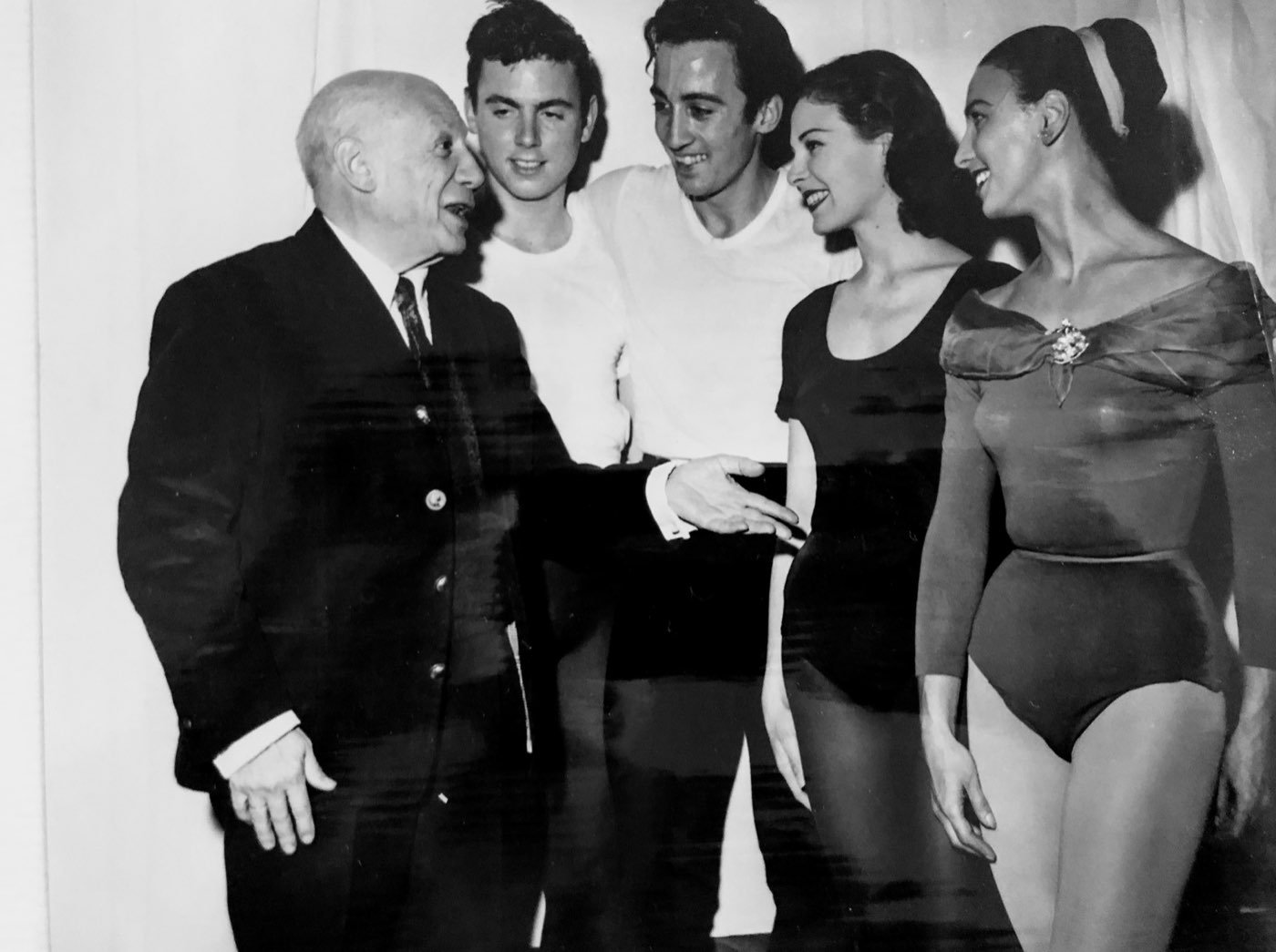
That it was the birthday, and the room the ballroom of the Hôtel Martinez, comes from one of the
dancers who was there. Maina Gielgud — then eleven, later artistic director of the Australian
Ballet — kept her own photograph of the night and named the small company that performed:
Nathalie Krassovska, Nicholas, Daphne Dale and Vasil Tupin, with herself the child of the
troupe.[18] Picasso's seventy-fifth fell on 25 October 1956.
Afterwards, by family account, Picasso signed and handed over one of the linocuts he cut himself for
Vallauris — the pottery town inland from Cannes, where the printer Hidalgo Arnéra pulled his
posters for the potters' association. It is his Toros en Vallauris, the 1956 bullfight
poster — the same year as the birthday: a yellow bull's head on red, the year lettered into the blue
above it. Picasso made one of these almost every year from the early 1950s, in editions, and
impressions of them are in the Art Institute of Chicago and elsewhere; he was known to sign them by
hand for people who came by.
A contemporary press notice of the evening has not yet surfaced — a Riviera gala like this one would
have been the province of Nice-Matin, which is not digitised. If you were there, or recognise the
room, we would be glad to hear from you.
October 1960: The Sleeping Beauty in Paris
The Marquis de Cuevas mounted one last great production, and Nicholas was in the middle of it.
The company's new Sleeping Beauty opened at the Théâtre des Champs-Élysées on
27 October 1960. Bronislava Nijinska — sister of Nijinsky, and one of the century's great
choreographers — began the production and was photographed rehearsing Vyroubova, Golovine, Hightower
and Nicholas; when she left, Robert Helpmann took it over and finished it.
Nicholas danced Prince Florimund opposite Rosella Hightower's Aurora, alternating in the role
with Serge Golovine.[19][20] A photograph of the two of them in the final scene ran in Dance and Dancers
under the caption "Wedding in Paris." The production was so successful it was held over.
It was the last the marquis would mount — he died the following year — and it has a further place in
ballet history. The Grand Larousse encyclopédique, listing its cast, includes one more name:
Rudolf Nureyev, who joined the production after his defection in 1961 and made his European
debut in it.
1962: On Tour with Serge Golovine
The Marquis de Cuevas died in 1961 and his company did not long survive him. Serge Golovine gathered
eight of its dancers into a touring group, and Nicholas went with them. When they played Geneva in
November 1962, Eugène Fabre singled out his bearing on stage, and called the David Lichine
adagio to Bizet — danced by Nicholas and Daphné Dale — one of the very great moments of the evening.[21]
A month later the company reached Fribourg, and Antoine Livio of La Liberté wrote the most
searching notice Nicholas ever received. Livio had been watching him for years, and opened with a
question:
"How is it that Nicholas Polajenko has made such progress?"
He had always had style and distinction, Livio went on, but there was now an assurance in his
variations, and a finish and precision he had gained by losing "that despairing nonchalance" the
critic had noted in his Prince Charming in The Sleeping Beauty. Of the Lichine adagio, danced again
with Daphne Dale, Livio wrote that they gave one of the purest emotions of the evening — a perfect
harmony served by a technique that never faltered.[22]
It is a rare thing to find in a newspaper: a critic who had followed a dancer long enough to notice
him change, and who said so.
1966: A Paris Tribute to the Marquis
In November 1966, at the fourth Festival international de danse de Paris, the Grand Ballet
Classique de France mounted a memorial programme to the late marquis at the Théâtre des
Champs-Élysées. Rosella Hightower, Genia Melikova, Michel Nunès, Nicholas Polajenko and James
Urbain were reunited with the Paris Opera étoile Liane Daydé to dance the old company's
repertoire — Constantia, Corrida and Lifar's Noir et Blanc. A Keystone press photograph of
Nicholas and Liane Daydé in Corrida on that stage survives in the Gamma-Rapho archive.
Every Major Classical Role
Between 1951 and 1968 Nicholas performed every major classical role. Among those now documented in
the contemporary press: Prince Florimund in The Sleeping Beauty (1961 and again in 1967), the
Bluebird pas de deux (1967), the Don Quixote pas de deux (1967), and Romeo (1968).[23]
Partner to Legendary Ballerinas
Nicholas partnered outstanding ballerinas including:
- Tamara Toumanova
- Marjorie Tallchief
- Alexandra Danilova
- Toni Lander
- Yvette Chauviré
- Svetlana Beriosova
- Rosella Hightower
Choreographers He Worked With
Nicholas worked with brilliant choreographers:
- Anton Dolin
- Nicholas Beriosoff
- Harald Lander
- Roland Petit
- Leonid Massine
- Serge Lifar
- Bronislava Nijinska
- Alvin Ailey
The Harkness Ballet
When Rebekah Harkness founded the Harkness Ballet in New York in 1964 — with George Skibine
as artistic director and choreography from Alexandra Danilova, Vera Volkova and
Alvin Ailey — Nicholas was engaged as guest premier danseur, with Marjorie Tallchief as
the company's prima ballerina. Ferdinando Reyna's Concise Encyclopedia of Ballet records the two
appointments together.
White House Performance
As a Guest Artist with the Harkness Ballet of New York, Nicholas was invited to perform at the White House before President Johnson.[24]
Dance Magazine Cover (November 1969)
Nicholas was pictured on the cover of Dance Magazine's November 1969 issue, working on the filming of Leonid Massine's "Blue Danube".
International Who's Who
His biography appears in a number of dance books and in the International Who's Who.
Part IV: Geneva and Meeting Anne
1966: Geneva Appointment
In 1966, Nicholas was appointed Principal Dancer & Ballet Master for the Ballet du Grand Théâtre in Geneva, Switzerland, then directed by Serge Golovine.
Geneva's two great newspapers — the Journal de Genève and the Gazette de Lausanne — reviewed the
company closely, and for the next six years Nicholas is a steady presence in their dance columns.
He arrived for the 1966-67 season, and both papers noticed him at once. Writing in the Gazette at
the end of October 1966, Brigitte Monneyron introduced him and Gerda Daum as newcomers to Geneva,
described their pas de deux as a moment of perfect harmony and great luminosity, and called him
a partner of perfect expression. The Journal's critic, writing under the name Lineka, found him
an expressive partner of great assurance.[25]
The Tribune de Genève had announced the engagement that May, reporting that he had arrived from
New York to take up the post after the Marquis de Cuevas company.[26] When the Geneva ballet appeared at
the Besançon festival that August, the same paper described him as the new danseur étoile who
had replaced Wladimir Skouratoff — the dancer whose place he had been hired to fill.[27]
Two critics, two verdicts
Not everyone was pleased. Reviewing the opening programme of that first season — in which Nicholas
had the lead in Le Chant du pavot — the Tribune de Genève was brutal. It called him "a newcomer
offering no particular quality," engaged with the title of étoile and "more mannered than
light," and finished by saying it would be pointless to go looking for étoiles of his level, since
ensemble work was worth more than titles that corresponded to nothing.[28]
It is worth knowing what that review was really doing: the whole piece is an argument for Serge
Golovine and for ensemble dancing against the star system, and Nicholas — five months in the
building, and the visible symbol of a hiring policy the critic disliked — was the example rather than
the subject.
The Courrier de Genève took the opposite view of the same seasons, and kept taking it. Its dance
critic Germaine Soullier called him and Liliane Van de Velde "the scintillating stars" of one
programme, and by May 1968, when he danced Romeo in Golovine's own choreography, she wrote
that he was "an elegant Romeo, expressive and of fine bearing." She noted that he and Van de
Velde were so well matched because they were partners all season long.[29]
Both verdicts are kept here. He arrived to a bad notice in Geneva's biggest paper and was dancing
Romeo to warm ones eighteen months later, and the second fact means more with the first beside it.
1967: A Season of Leading Roles
That season Nicholas danced the male lead in Golovine's Le Chant du Pavot, to Marcel
Landowski's concerto for ondes Martenot, in sets by Théodore Strawinsky; the toreador in
Lichine's Corrida;[30] and, in April, the Don Quixote pas de deux with Liliane Van de
Velde at a gala marking the twentieth anniversary of the United Nations Economic Commission for
Europe, with the Orchestre de la Suisse Romande in the pit.[31]
In May 1967 the company staged its first full-length work, a complete Sleeping Beauty conducted
by the young Armin Jordan. Nicholas and Liliane Van de Velde danced the Bluebird — Van de
Velde, his partner in nearly everything he danced in Geneva, being also Serge Golovine's wife.[32] That
August, at the Théâtre de Verdure, the two of them returned to the ballet as Prince Désiré and
Princess Aurora, in what one critic called an agreeable impression of assurance, precision and
well-placed energy.
That October, Golovine's company gave the first performance of Contraste, to a score by the
Swiss composer Armin Schibler. It was a two-hander: a psychological dance poem built on the
opposition of Man — Nicholas — and Woman, Beatriz Consuelo, with two groups of dancers ranged on
a raised backdrop standing for the pair's consciences. Victor Reinshagen conducted the Orchestre de
la Suisse Romande. The Neue Zürcher Zeitung called Schibler's music ideal for dancers and reported
that the audience wanted the piece brought back soon.[33]
1968: Danseur Étoile
By this point the Geneva papers list Nicholas by the company's highest rank — danseur étoile —
above the premiers danseurs and a corps of thirty-two. In April 1968 he danced the Devil in
Stravinsky and Ramuz's L'Histoire du soldat, in choreography by Golovine.[34] In May he alternated
in the lead of Les Amants de Vérone, the company's Romeo and Juliet.
That June the Ballet du Grand Théâtre appeared in Lausanne for the first time, at the Palais de
Beaulieu.[35] Golovine was injured in rehearsal and the Royal Danish Ballet's Nils Kehlet came in to
replace him, surrounded — as the Gazette put it — by our étoiles Beatriz Consuelo, Liliane Van de
Velde and N. Polajenko. Reviewing the evening, Monneyron called him the athletic Nicholas Polajenko.
When the company opened its next season in October 1968 under the choreographers Ottavio
Cintolesi and Nicolas Beriosov, the Gazette reported that the training of the dancers now fell
to Beatriz Consuelo and to Nicholas — the ballet-master role he would carry for the rest of his time
in Geneva, and for the rest of his working life.[36]
The Neue Zürcher Zeitung explained how that had come about, and was blunter about the state the
company was in. Serge Golovine had left the troupe and the theatre only weeks before the season
opened, and Beatriz Consuelo had been unwell throughout the preparations.
She and "her colleague Nicholas Polajenko," the paper wrote,
would have no easy job holding the company's technical level
and raising it further. Its verdict on the opening night of 1 October was severe — Cintolesi's
Concerto, set against Vivaldi's Four Seasons, was dismissed outright. But the evening's premiere,
Cintolesi's Manu-Tara to a prize-winning score by Jean Derbès, fared better, and among the
dancers the critic singled out was Nicholas, dancing the Sea.[37]
1969: Houston, four years early
The teaching career is usually dated from the move to America in 1973. It began earlier than that,
and it began in Geneva.
Nicholas ended his engagement as danseur étoile at the close of 1968. At the start of 1969 he
was called to Houston — to organise a dance school funded by a private foundation. Having done
it, he flew home. A photographer met him at Geneva's Cointrin airport coming down the aircraft steps,
and La Suisse ran the picture in February 1969 above an article about what he would do next.
What he did next was teach. He took charge of classes at a beauty school on the rue de la
Confédération — amateur classes in "gym-jazz," a method the paper credited him with originating,
built on gymnastic exercise set to jazz. He had already taught it, with great success, to staff of
Geneva's international organisations, which is how the school came to want him. Through 1969 and
1970 he advertised classes in the city and out at Meyrin.[38][39]
There is a small coincidence in that. The international civil servants he was teaching gym-jazz to
worked for the same Geneva institutions that had employed Anne's father for most of his career.
And the Houston commission was not a detour. Five years later he would be ballet master of Houston
Ballet, and two years after that he and Anne would found a school of their own there. The Texas
thread starts with this trip.
1968-1972: Ballet for Television
Swiss television brought the Geneva company to a national audience, and Nicholas with it. In
September 1968 he and Liliane Van de Velde led the corps in Fokine's Les Sylphides,
broadcast on Télévision Suisse Romande.[40]
Three years later came something more unusual. For the series Le Ballet au XXe siècle, TSR
commissioned Maldoror, a dramatic ballet after Lautréamont's Les Chants de Maldoror, with an
electronic score by Jean Derbès and choreography by Ottavio Cintolesi. Nicholas danced the
title role. It was first broadcast in May 1971 and shown again in April 1972 — the last trace of his
performing career in the Swiss press, and one of the few of his roles preserved on film.[41]
Meeting His Wife
While at the Geneva Grand Theatre, Nicholas met his future wife, Anne.
Anne had been watching him partner Toni Lander years earlier in Rome and later wrote that he was "a young man I would marry many years later."
They were dancing in the same company. Reviewing the Geneva Sleeping Beauty in May 1967, the
Gazette de Lausanne praised an excellent pas de trois danced by Anne Saint Pol with Christl
Siesz and Claude Darnet — on the same stage, in the same production in which Nicholas danced the
Bluebird.
Part V: Teaching Career (1973-2015)
1973: Move to U.S.
In 1973, Nicholas and Anne moved to the United States to pursue teaching careers.
Point Park College, Pittsburgh (1973-1974)
The Polajenkos' first teaching position in America.
Houston Ballet (1974-1976)
Nicholas was hired as ballet master by Nina Popova, herself a former Ballet Russe and Ballet
Theatre dancer, who was then building Houston Ballet into a professional company. The company's own
history names him among the small group she brought in — Michael Lland, Nicholas Polajenko, James
Clouser and Eugene Tanner — in successive long-term positions as teachers, choreographers or
ballet masters.
They were turbulent years. Popova resigned abruptly in February 1975; Clouser, the company's
resident choreographer, served as acting artistic director while the board searched for a
successor. In 1976 it chose Ben Stevenson, who would lead Houston Ballet for the next
twenty-seven years.
Nicholas and Anne ran the company's ballet staff through that transition season. The Dance World
yearbook for 1976 sets out Houston Ballet under Stevenson as artistic director, with Clouser as
acting artistic director and choreographer, and lists the staff beneath them:
Ballet Masters, Hiller Huhn, Nicholas Polajenko; Ballet Mistress, Anne Polajenko
It was a hard changeover for the dancers Nicholas had been teaching: seventeen of the company's
twenty-eight were told their contracts would not be renewed, and Clouser resigned. In the same
season Houston Ballet bought new ground-level quarters on Colquitt and left the second-floor
studios at 2018 West Gray it had occupied since 1964.[42]
Houston Dance Center (1976-1988)
Within months, Anne and Nicholas had opened their own school in those vacated West Gray studios,
with James Clouser on the faculty. The Houston Dance Center enrolled its first students for a
fall semester beginning September 7, 1976. It was constituted as a non-profit educational
organization supported by contributions — not a commercial studio.
The local press announced it plainly:
"The Houston Dance Center, an exciting new concept in dance training, begins classes this week at
2018 West Gray. The non-profit educational organization is directed by two of Houston's best known
and admired dancer-teachers, Anne and Nicholas Polajenko."
The curriculum said something about what the two of them thought a dancer needed. Alongside
classical ballet, pre-ballet, modern, jazz and yoga, the Center taught dance history, music
theory and dance journalism — an academic spine unusual in a private school, and recognisable
from the European state companies where both had spent their careers.
The Center also ran a performing company, Festival Ballet USA, through which students
apprenticed into professional work. It presented an evening of classical and contemporary ballet at
Hamman Hall, Rice University in May 1978 to benefit the school's scholarship fund — a program
of works by Anne and Nicholas, Gilbert Rome and James Clouser — and it travelled, dancing for
Galveston Arts at the 1894 Grand Opera House in June 1982.[43] Suburban schools across the Houston
area affiliated themselves with the Center and advertised the connection as a credential.
Each summer the Polajenkos taught a repertoire workshop for advanced dancers and teachers, working
through sections and pas de deux from Les Sylphides, Swan Lake, The Sleeping Beauty and Pas
de Quatre. The announcement is precise about the point of it: they would teach "not only the
choreography, but the styles of each ballet."
Over twelve years the Center placed dancers in major schools and companies in New York, San
Francisco and beyond — among them Lee Hutton, who went on to the Joffrey II Dancers, and
Courtney Laves, who trained there on full scholarship before joining the Atlanta Ballet and the
South Carolina Ballet Theatre.
Nice, and the Grande Parade du Jazz (1985)
In 1985 the school's reach extended across the Atlantic. Nicholas and Anne took a troupe of Houston
Dance Center dancers to Nice — a sister city of Houston — for a joint concert tour with the
Jazz Ensemble of Houston's High School for the Performing and Visual Arts, directed by Robert
"Doc" Morgan. The Center's dancers appeared alongside the young musicians, whose sets at the
Grande Parade du Jazz — the open-air festival then produced by the American impresario George
Wein — had been arranged for the tour.
Two Houston papers recorded it in 1985. A July dance-school notice in the South Belt Leader noted a
student, enrolled at HSPVA, "in Nice, France by invitation of the French government," performing at
the opening of the city's new Acropolis convention center — a dancer "on scholarship at the Houston
Dance Centre under the direction of Anne and Nick Polajenko."[44] In November, The
Texan recalled the HSPVA ensemble as having been "such a sensation at the 1985 Grand Parade du Jazz
in Nice, France."[45]
Morgan filmed the visit on Super-8 and posted the edited reel in 2015; its opening cards credit
"Dancers from the Houston Dance Center, Nick and Anne Polajenko, directors."
Watch the film.[46]
Master Classes
Nicholas conducted master classes throughout his teaching career. In December 1976, months after
opening the Center, he taught the first in a series at the Jewish Community Center of Houston,
a series that went on to feature Anne and James Clouser. The Center's newsletter introduced him to
its members this way:
"Polajenko is the co-director, with his wife Anne, of the new Houston Dance Center and the former
Ballet Master of the Houston Ballet. His career began in Canada followed by tours of the U.S. both
as principal dancer and later as director of his own ballet troupe, 'Ballet Quartet.' He studied
under Anatole Vilzak, Mme. Schollar, Aubrey Hitchins, Olga Preobrajenska and Harold Lander."
The following year he taught ballet technique in a college dance program at the University of
Houston at Clear Lake City, again alongside Clouser.
Harid Conservatory, Boca Raton (1988-1989)
Anne and Nicholas were engaged as the Conservatory's first ballet instructors.[47]
Students' Success
Polajenko-trained dancers joined major companies:
- San Francisco Ballet
- Ballet West
- Dallas Ballet
- Joffrey II
- New York City Ballet
- Berlin Ballet
- Frankfurt Ballet
Part VI: Later Roles and Character Work
Character Performances
Nicholas's character interpretations drew rave reviews:
- Drosselmeyer in The Nutcracker
- The grumpy Grandfather in Peter & the Wolf
"his character interpretations of such roles as Drosselmeyer in the Nutcracker and the grumpy Grandfather in Peter & the Wolf are drawing rave reviews."
Website Newsletters
From July 2011 Nicholas wrote the newsletters for the pointe-shoe website he and Anne ran together.
Their writing from it is preserved in Anne's Pointe Shoe Guide.
Part VII: Civic Activities
Nicholas served on:
- Dance Panel of the Cultural Arts Council of Houston
- Board of the American Guild of Musical Artists
- Sister Cities International Program
Death and Legacy
August 4, 2015
Nicholas Polajenko passed away on August 4, 2015 in Delray Beach, FL.
He was survived by wife Anne, son, and two grandchildren.
Nicholas Polajenko Memorial Scholarship
The Polajenko family established a scholarship in Nicholas's memory at Southern Dance Theatre for the 2017-18 school year.
"The Polajenko family is pleased to announce the creation of a scholarship in memory of Nicholas Polajenko... This scholarship is meant to assist one dancer with tuition costs at Southern Dance Theatre for the school year 2017-18."
First recipient: Savanna Bourque ($1,000 scholarship + $750 So Dança gift certificate)
In the Archives
Much of Nicholas's career survives in institutional collections. Most of this material is still under
copyright and cannot be reproduced here, but it can all be read or viewed at the source.
Film and photographs
- Jacob's Pillow Dance Interactive — silent 16mm film of the original 1952 cast of Antony Tudor's Trio con Brio: Tatiana Grantzeva, Nicholas Polajenko and Ralph McWilliams. Thought lost until 2008.
- The Antony Tudor Ballet Trust — the Trust's record of Trio con Brio, its premiere and its reconstruction.
- Getty Images / Keystone-France — press photograph of Nicholas with Liane Daydé in Corrida, Théâtre des Champs-Élysées, 23 November 1966.
Newspapers
- Le Temps archives — free, full-text searchable. Twenty-eight articles in the Journal de Genève and the Gazette de Lausanne between 1958 and 1972 name Nicholas, including signed reviews by Jean Nicollier, Eugène Fabre, Brigitte Monneyron and Antoine Livio.
- Chronicling America — the Library of Congress newspaper archive, free and in the public domain. Source of the 1951 clipping above.
- The Portal to Texas History — the University of North Texas newspaper archive, free and full-text searchable. Forty-one items name Nicholas, including the Houston Dance Center's opening advertisement of August 1976 and the Houston-area weeklies that covered the school for the next decade.
Stage and reference
- Broadway World — his 1947 Broadway credit in Music In My Heart, listed under the spelling "Nicolai Polajenko."
- Houston Ballet — the company's own history of its fledgling years, when Nicholas was ballet master.
- HARID Conservatory — the Conservatory's anniversary retrospective, recalling Anne and Nicholas as its first ballet faculty.
See also: Anne Polajenko | Saint-Pol Family History | Anne's Pointe Shoe Guide | Student Reflections
References
Horst Koegler, The Concise Oxford Dictionary of Ballet, Oxford University Press, 1982, p. 330. ↩︎
"Who's Who in the Cast", Roland Petit's Les Ballets de Paris, The Playgoer, 1951, p. 35. ↩︎
Alice Eversman, "News of Music: 'Die Fledermaus' Opens at Gayety With Splendid Singing and Acting", The Evening Star, 26 December 1951, p. B-6. View ↩︎
"Around the World", Dance Digest, vol. 4, no. 4, April 1954. ↩︎
"London's Festival Ballet", Dance and Dancers, vol. 5, no. 9, September 1954. ↩︎
"Festival Ballet: Esmeralda", Ballet Today, vol. 7, no. 9, September 1954. ↩︎
Peggy Van Praagh and Peter Brinson, The Choreographic Art, Adam and Charles Black, 1963. ↩︎
"Partied", Dance Magazine, vol. 28, no. 11, November 1954. ↩︎
"London Letter", Dance Digest, vol. 5, no. 11, December 1955. ↩︎
"News from Latin America", Dance Magazine, vol. 31, no. 2, February 1957. ↩︎
Tardy and Marcus, "Tanz in Paris", Neue Zürcher Zeitung, 15 August 1957, Edition 02. View ↩︎
"Corrida", Journal du Jura, 15 September 1969; and "Radio-TV", La Suisse, 15 September 1969. ↩︎
Jean Nicollier, "Nouvelle et notable visite du Grand Ballet du Marquis de Cuevas", Gazette de Lausanne, 21 July 1958, p. 3. View ↩︎
Eugène Fabre, "Un admirable spectacle de l'International Ballet of the Marquis de Cuévas", Journal de Genève, 4 August 1959, p. 7. View ↩︎
Eugène Fabre, "Le Ballet Cuevas est apparu dans une forme splendide", Journal de Genève, 4 August 1961, p. 9. View ↩︎
"Kleine Chronik", Neue Zürcher Zeitung, 11 January 1959. View ↩︎
Maina Gielgud, caption to a photograph of the Cannes performance, Facebook, 5 August 2025 (the image itself first posted 26 October 2012): "After show in Cannes for Picasso birthday with Nathalie Krassovska Nicholas Polajenko Daphne Dale Vasil Tupin, I was 11. We danced in Ballroom of Hotel Martinez." View ↩︎
Ferdinando Reyna, Concise Encyclopedia of Ballet, Follett, 1974, pp. 107, 111, 210. ↩︎
"Belle au bois dormant, la", Grand Larousse encyclopédique. ↩︎
Eugène Fabre, "Serge Golovine au palais des Expositions", Journal de Genève, 16 November 1962, p. 13. View ↩︎
Antoine Livio, "Chorégraphie: Le Ballet Serge Golovine", La Liberté, 7 December 1962, p. 21. View ↩︎
Anatole Chujoy and P. W. Manchester, eds., The Dance Encyclopedia, Simon and Schuster, 1967, p. 425. ↩︎
"The Johnson White House: 1963–1969", White House Historical Association. View ↩︎
Brigitte Monneyron, "Les ballets du Grand Théâtre", Gazette de Lausanne, 31 October 1966, p. 4. View ↩︎
"Nouveau danseur étoile au Grand-Théâtre", Tribune de Genève, 25 May 1966. ↩︎
"Les Francs-Comtois plus heureux que les Genevois: le ballet du Grand-Théâtre au festival de Besançon", Tribune de Genève, 29 August 1966. ↩︎
"Six représentations et trois créations de Golovine pour le ballet (modifié) du Grand-Théâtre", Tribune de Genève, 29 October 1966, p. 11. View ↩︎
Germaine Soullier, "Au Ballet du Grand-Théâtre: «Roméo et Juliette» changent de visage", Courrier de Genève, 17 May 1968, p. 4. View ↩︎
"Les «Sylphides» et autres ballets", Journal de Genève, 27 February 1967, p. 14. View ↩︎
Pierre Para, "Concert de gala, spectacle de ballets et création d'un concerto de Julien-François Zbinden", Journal de Genève, 13 April 1967, p. 12. View ↩︎
"Soirée de ballet au Grand-Théâtre: «La Belle au bois dormant»", Journal de Genève, 3 May 1967, p. 18. View ↩︎
"Musik in Genf", Neue Zürcher Zeitung, 24 October 1967. View ↩︎
Robert Cornman, "L'Histoire du soldat", Journal de Genève, 8 April 1968, p. 10. View ↩︎
Brigitte Monneyron, "Dans le cadre du Festival de Lausanne, le Ballet du Grand-Théâtre de Genève", Gazette de Lausanne, 5 June 1968, p. 6. View ↩︎
"Le ballet retrouve des chorégraphes", Gazette de Lausanne, 3 October 1968, p. 5. View ↩︎
"Ballettabend in Genf", Neue Zürcher Zeitung, 4 October 1968, Edition 03. View ↩︎
"Des étoiles fidèles à Genève", La Suisse, 24 February 1969, p. 47. View ↩︎
"Nicholas Polajenko à Meyrin", La Suisse, 21 September 1969. ↩︎
"A la télévision", Journal de Genève, 20 September 1968, p. 15. View ↩︎
"Maldoror en images", Journal de Genève, 1 May 1971, p. 28. View ↩︎
"Houston Dance Center Begins Classes This Week", The Bellaire & Southwestern Texan, vol. 24, no. 51, 8 September 1976, p. 5. ↩︎
"Galveston Hosts Houston Dancers", The Baytown Sun, 18 June 1982, p. 10. View ↩︎
"dance news", South Belt Leader (Houston), vol. 10, no. 23, 11 July 1985, p. 11. View ↩︎
"HSPVA holds jazz bash", The Texan (Bellaire, Tex.), vol. 32, no. 10, 6 November 1985, p. 11. View ↩︎
HSPVA Jazz Ensemble and Houston Dance Center in France, 1985, film by Robert "Doc" Morgan (Super-8 with sound, 1985; edited and posted to YouTube, 2015). View ↩︎
"First Love: A 25th Anniversary Retrospective", The HARID Conservatory. View ↩︎